Materials, Fabrication & Technology in Commercial Public Art Sculpture
Contemporary commercial and public art sculpture sits at the intersection of traditional craftsmanship and advanced fabrication technology. For architects, developers and public bodies commissioning permanent works, understanding how sculpture is made is essential — not only for aesthetics, but for durability, safety, scalability and long-term value.
Unlike decorative artwork, commercial sculpture must perform structurally, integrate with architecture, and endure continuous public interaction. This demands a fabrication approach that balances artistic authorship with engineering discipline and production capability.
At Charles Elliott Sculpture, we deliver commercial sculpture projects internationally using a hybrid fabrication process that combines hand craftsmanship with modern digital tools. Early discussions around materials and fabrication strategy are always welcomed and can be arranged by emailing
Call +44 (0) 1494 758 896 or email studio@charleselliott.com
Material Selection in Commercial & Public Art
Material choice is one of the most important decisions in any commercial or public art commission. It affects appearance, performance, maintenance and how the sculpture is perceived over time.
The most commonly specified materials for public and commercial sculpture include:
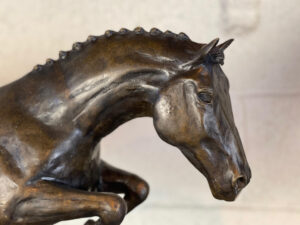
Bronze, for permanence, cultural significance and long-term durability
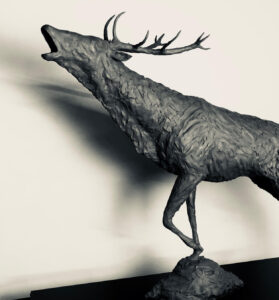
Steel, for scale, structural presence and architectural integration
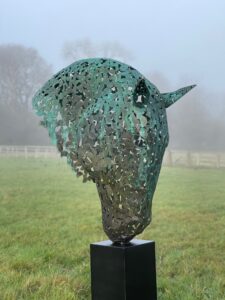
Mixed materials, where contrast and performance requirements demand it
Each material behaves differently in public environments. Bronze offers exceptional longevity and develops patina over time. Steel provides strength and scale but requires appropriate finishing systems depending on exposure. Selecting the right material is always a balance between concept, environment and lifecycle expectations.
Traditional Craftsmanship: The Foundation of Sculpture
Despite advances in technology, traditional sculptural processes remain central to high-quality commercial sculpture.
These include:
Hand-fabricated armatures and structures
Welding and metal forming by experienced fabricators
Bronze casting and hand-finishing
Surface refinement and detailing for public interaction
These methods provide the tactile quality and artistic nuance that define sculptural work. They also allow forms to be adjusted by eye and hand — something no automated process can fully replace.
For public and commercial environments, craftsmanship is not only about appearance. It ensures robustness, safe edges, and structural integrity suitable for long-term use.
Digital Fabrication: Precision, Scale and Repeatability
Where commercial projects increase in scale or complexity, digital fabrication technologies play a crucial supporting role.
We regularly integrate:
CNC cutting and machining for accuracy and consistency
Five-axis machining for complex junctions and sculptural geometry
3D printing and rapid prototyping for model development and testing
These tools allow complex forms to be resolved precisely before fabrication begins. They are particularly valuable for large sculptures, multi-part assemblies, or projects involving multiple installations across different sites.
Importantly, these technologies support — rather than replace — craftsmanship. They ensure that artistic intent can be delivered efficiently, predictably and safely at commercial scale.
Bronze Casting in Contemporary Public Art
Bronze remains a cornerstone material for public art and commercial sculpture. While the material is historic, the way it is used today is highly refined.
Modern bronze fabrication combines:
Digital modelling to resolve form and thickness
Casting processes that ensure structural reliability
Hand-finishing to achieve surface quality and detail
Bronze is particularly well suited to international projects, as its performance characteristics are well understood globally. This predictability reduces risk for overseas delivery and long-term maintenance.
If you are considering bronze for a commercial or public art project, material and fabrication options can be discussed by contacting
Call +44 (0) 1494 758 896 or email studio@charleselliott.com
Fabrication for Architecture, Not Just Art
One of the key distinctions between decorative artwork and commercial sculpture is the requirement to integrate with architecture and landscape.
Fabrication decisions are often influenced by:
Structural loading and foundations
Fixing methods and anchoring systems
Coordination with contractors and landscapers
Integration with lighting and services
Compliance with public safety standards
This is why commercial sculpture fabrication must be approached with the same seriousness as architectural elements. Technical resolution is not separate from creative intent — it is part of it.
Scalability and Multi-Site Projects
Increasingly, commercial and public art commissions involve more than one sculpture. Corporate campuses, hotel groups and civic programmes may require multiple works delivered across different locations.
Digital fabrication methods allow:
Consistency across multiple sculptures
Efficient production planning
Reduced variation without loss of character
This scalability is essential for international projects where consistency, logistics and programme certainty matter.
Fabrication, Logistics & International Delivery
Fabrication cannot be separated from logistics. Sculpture must be fabricated with transport, lifting and installation in mind from the outset.
Considerations include:
Modular construction for transport
Crating and protection systems
Weight distribution and lifting points
Installation sequencing on site
Our studio regularly manages international sculpture delivery, coordinating fabrication, transport and installation as a single process. This integrated approach reduces risk and ensures that sculpture arrives ready for installation, wherever the project is located.
International enquiries can be discussed by emailing
✉️Call +44 (0) 1494 758 896 or email studio@charleselliott.com
Fabrication as Part of Long-Term Value
For commercial and public clients, fabrication quality directly affects long-term value. Well-fabricated sculpture:
Requires minimal maintenance
Performs reliably in public environments
Retains visual integrity over time
Enhances perception of quality and permanence
This is why fabrication should never be treated as a secondary consideration. It is fundamental to how sculpture performs as part of the built environment.
Delivering Commercial Sculpture with Confidence
At Charles Elliott Sculpture, we approach materials and fabrication with the same care as artistic concept. Our hybrid process — combining craft, technology and delivery experience — allows us to support ambitious commercial and public art projects in the UK and internationally.
If you are exploring a commercial sculpture, public art installation, or architectural artwork and would like to discuss materials, fabrication or feasibility, we welcome early conversations.
Call +44 (0) 1494 758 896 or email studio@charleselliott.com