Bronze Sculpture for Gardens and Public Spaces: Material, Scale and Lasting Presence
Bronze holds a distinctive position in sculpture, valued not only for its durability but for its permanence, refinement and cultural weight. Across private gardens and public spaces alike, bronze sculpture for public spaces shapes how an environment is experienced: it sets atmosphere, guides movement, and anchors architecture within its surroundings.
For a British sculptor working internationally, bronze is a language that translates across contexts. Placed within a private estate, a commercial development or a civic setting, its presence stays consistent. It ages with dignity, responds to light, and evolves with its environment rather than against it.
Why bronze remains central to outdoor sculpture
The enduring relevance of bronze lies in the balance between strength and sensitivity. Structurally it can carry large-scale work without losing fine detail. Visually it offers a surface that shifts over time, developing subtle tonal changes through exposure to air, moisture and touch.
Unlike lesser materials, bronze does not degrade in a way that diminishes it. It matures. That quality makes it particularly suited to outdoor bronze sculpture, where interaction with the elements is inevitable. For architects and landscape designers, this reliability is critical: a piece placed within a designed scheme must complement its setting at installation and continue to do so for decades.
Bronze in public and commercial settings
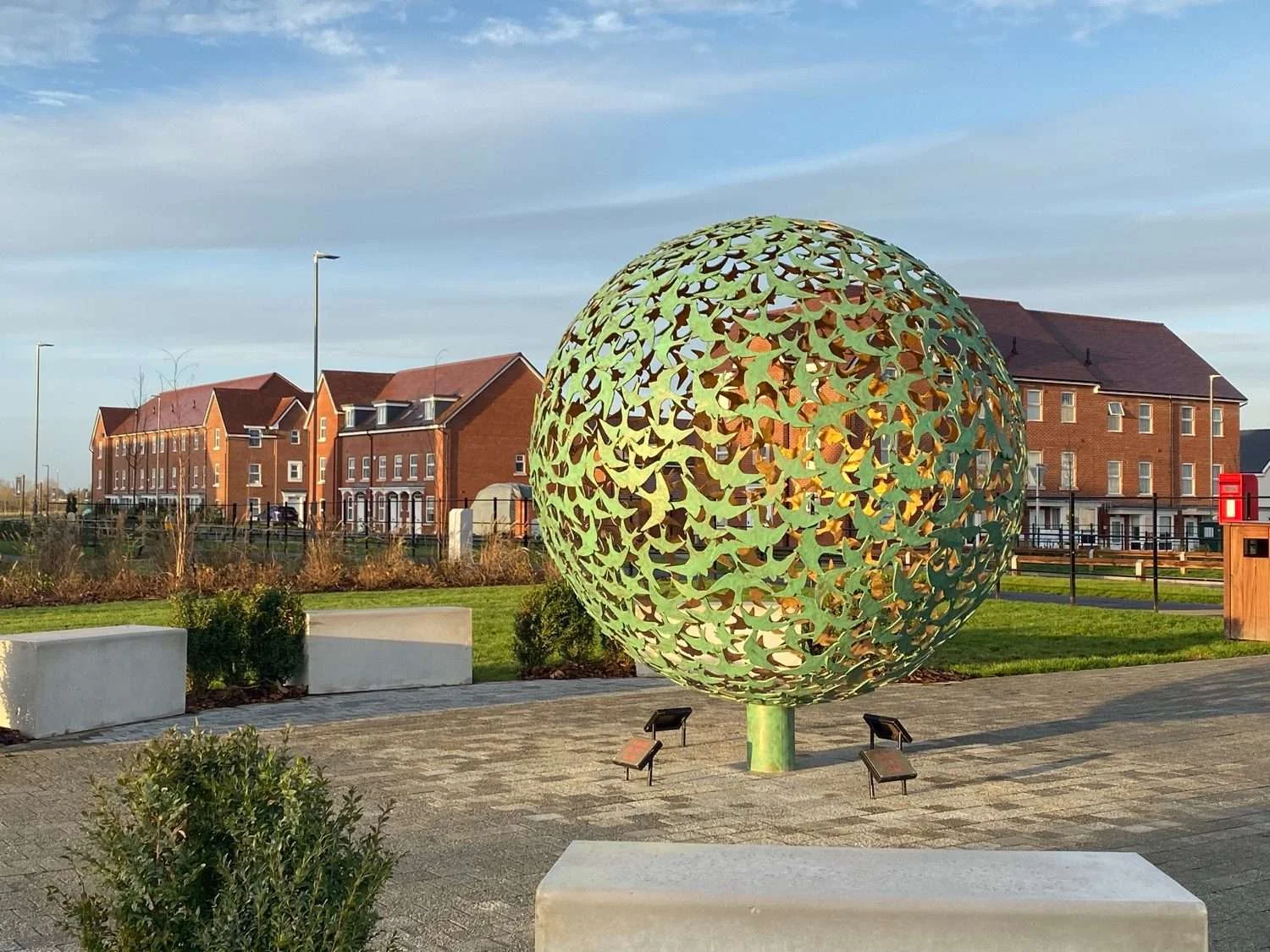
In public and commercial contexts, sculpture works hard. It has to engage a broad audience while holding a sense of permanence and relevance. A bronze public artwork frequently becomes part of a place’s identity, acting as a landmark, a meeting point or a visual anchor within a development or urban space. Its durability lets it withstand heavy public interaction, while its evolving surface quietly registers the passing of time.
For developers and planners, commissioning commercial sculpture in bronze is not only an aesthetic decision. It contributes directly to placemaking, reinforcing the character and quality of a scheme, supporting sales and lettings, and giving a development a name people remember. Where public art forms part of a planning obligation, bronze is often the material of choice for exactly these reasons. We cover that route in full in our guide to Section 106 and public art.
Planning a public or commercial commission? We deliver bronze public art end to end, from concept to installation. Talk to our studio.
Bronze in garden settings
In private landscapes bronze often serves as a focal point, though rarely a dominant one. Its role is more considered. It can mark an axis within a formal garden, sit in quiet dialogue with planting, or offer a sculptural counterpoint to organic forms.
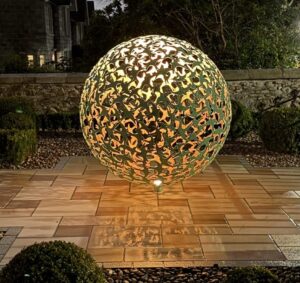
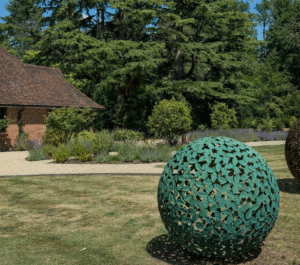
Bronze sits comfortably within both traditional and contemporary gardens. A cast bronze piece may carry classical references, while a more abstract form reinforces modern design. In large garden sculpture, scale becomes essential: a piece must be substantial enough to hold presence in open space, yet balanced so it never overwhelms. Bronze gives that equilibrium, visual weight without heaviness. For private estate settings specifically, see our guide to luxury garden sculpture.
The role of patina
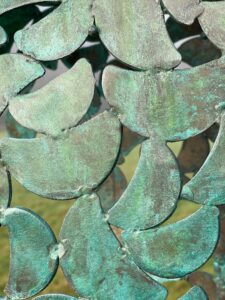
One of bronze’s most distinctive qualities is its surface. Through patination, a wide spectrum of tones can be achieved, from deep browns and warm golds to the greens associated with verdigris. Patina is not merely decorative; it shapes how a sculpture interacts with its environment. A darker finish absorbs light and reads as solidity, while lighter or green tones respond more dynamically to changing conditions.
These finishes continue to evolve after installation, which is part of the appeal: the form stays fixed, but the surface is never entirely static. We explain the process and the options in aged bronze and verdigris finishes.
Working at scale
Creating large-scale bronze involves both technical precision and spatial awareness. From concept through casting to installation, each stage has to consider how the piece will exist in its final setting. Scale is not simply size; it is proportion in relation to surroundings. In expansive landscapes a sculpture must command space without disrupting it; in more contained settings it must integrate while keeping presence.
For significant projects this calls for close collaboration between sculptor, architect, landscape designer and client, so the finished piece aligns with both the design vision and the practical constraints of engineering, foundations and installation.
British sculpture in an international context
There is a long association between British bronze sculptors and high-quality, site-specific work, and that reputation carries globally across private estates, luxury developments and public commissions. A British studio working internationally brings technical expertise together with a considered approach that prioritises longevity, material integrity and contextual sensitivity. In that sense bronze is more than a medium; it is part of a wider architectural and cultural conversation.
How Charles Elliott Sculpture helps
We create bronze sculpture for gardens, developments and public spaces, and we deliver it as a fully considered, end-to-end service, in close partnership with developers, architects, landscape architects and private clients. From concept and scale models through engineering, fabrication, patination and installation to aftercare, one studio holds the whole commission, so the delivery risk stays off your desk and the finished piece belongs in its setting.
If you are considering a bronze commission for a public, commercial or private space, we would welcome an early conversation.
Discuss your project with our studio | Make a private commission enquiry
Frequently asked questions
Is bronze suitable for public spaces? Yes. Bronze is one of the most durable sculptural materials, able to withstand heavy public interaction and the elements while developing character over time, which is why it is so widely used for public art and landmarks.
How long does bronze sculpture last outdoors? Properly made and patinated, bronze lasts for generations. Its patina acts as a protective layer, and rather than degrading it matures, developing depth of surface over decades.
What size should a bronze sculpture be for a garden or public space? Scale is about proportion to the setting, not size alone. In open landscapes a piece needs enough presence to hold the space; in contained settings it must integrate while remaining a focal point. We advise on this at design stage.
Can you deliver a bronze commission internationally? Yes. We work on international projects, coordinating design, engineering, fabrication and installation to suit the site and local conditions.
Written by Charles Elliott, founder and sculptor. For advice on a specific project, contact the studio.
Thinking about a bronze sculpture of your own?
Every piece leaves one studio. Designed, cast or hand-fabricated in silicon bronze, patinated and installed by the people who made it. Work ranges from tabletop pieces to landmark sculpture at fifteen metres and beyond.
See how a bronze sculpture is made, what it costs and how long it takes on our bronze sculpture page.
Explore bronze sculptureBook a call with CharlesOr speak to the studio on +44 (0) 1494 758 896