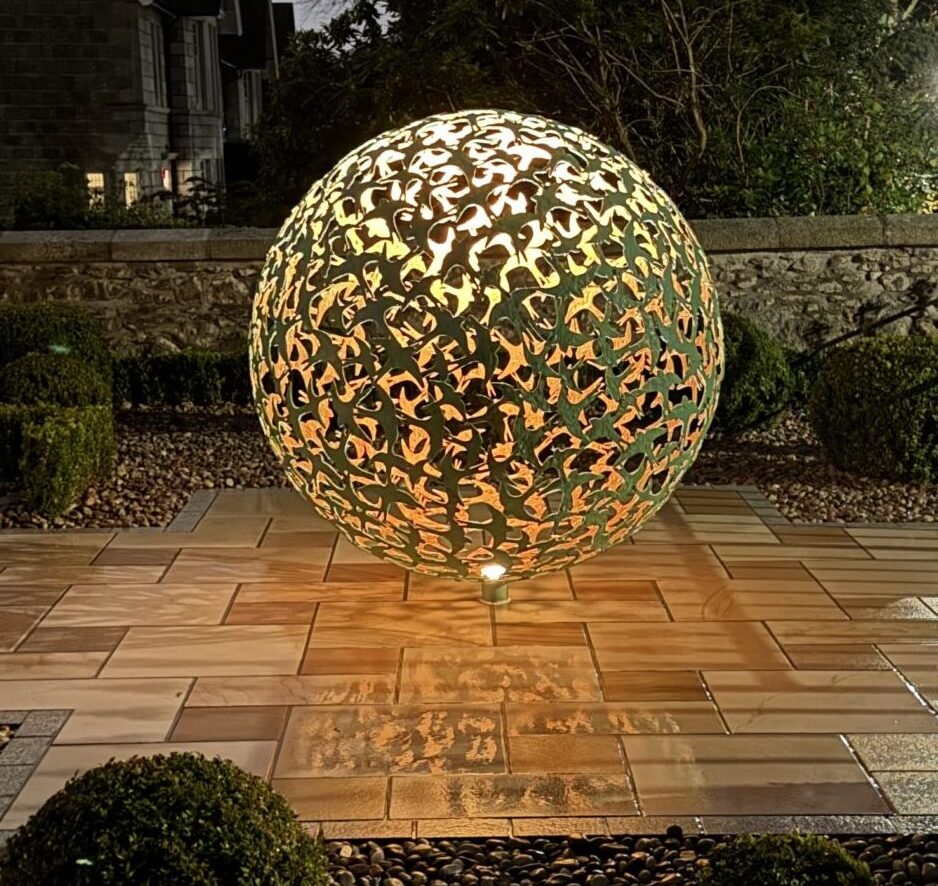
Bronze Sphere Sculpture: A Timeless Form for Gardens and Architecture
Few forms have the universal appeal of the sphere. Simple in geometry yet endlessly open to interpretation, it holds a unique place in sculpture. From formal landscapes and contemporary gardens to commercial developments and public spaces, bronze sphere sculpture remains one of the most enduring sculptural forms. Its appeal lies not in decoration but in how it engages with space, light and architecture in a way that feels both timeless and contemporary. For a British sculptor working internationally, the sphere offers remarkable versatility across very different environments and design briefs.
The power of a simple form
The sphere is one of the most fundamental shapes in nature and mathematics. Unlike highly representational work, it imposes no fixed narrative; it invites interpretation and reflection, and its visual language is universal, sitting comfortably within a wide range of cultural and architectural settings.
That simplicity is deceptive. A sphere’s relationship with its surroundings is always changing: reflections shift with the light, weather alters the surface, and the piece transforms as you move around it. The result is a form that feels dynamic despite being entirely still.
Bronze as the ideal material
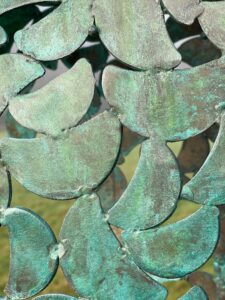
Bronze has become closely associated with the sphere for its durability, surface richness and ability to age gracefully. It lets a sculptor create a form that is both substantial and refined, and whether finished with a deep aged patina or a lighter verdigris surface, it responds beautifully to changing conditions. Outdoor bronze sculpture thrives on this relationship with the natural world, as rain, sunlight, the seasons and surrounding planting all shape how the piece looks over time. You can read more on finishes in aged bronze and verdigris finishes, and on the material itself in our complete guide to bronze sculpture.
Bronze sphere sculpture in garden design
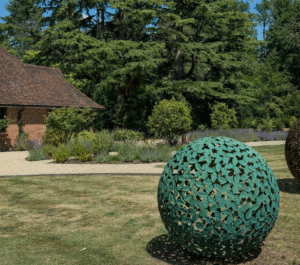
In a garden, a sphere brings balance and visual calm. The contrast between geometric precision and organic planting creates a dialogue that flatters both, introducing order without rigidity so the form works in formal and naturalistic landscapes alike. Garden designers use bronze sphere sculpture to create focal points, mark sightlines, anchor open spaces, and add sculptural interest across the whole year. Unlike a planting scheme, a sculpture is a constant presence, holding visual structure whatever the season.
Thinking about a sphere for your garden or scheme? We create bespoke sphere sculptures scaled and finished for the setting. Make an enquiry.
Scale and landscape
One of the sphere’s great strengths is how it adapts across scale. A smaller sphere makes an intimate focal point in a courtyard or enclosed garden, while a monumental sphere can define an entire landscape. Large garden sculpture needs a form that holds presence without becoming visually heavy or overly complex, and the sphere achieves that balance naturally: its symmetry commands attention while staying harmonious in expansive settings. For private estates and luxury landscapes, that mix of strength and restraint is especially valuable.
Architecture and the sphere
The sphere and modern architecture make natural partners. Contemporary buildings rely on clean lines, angular forms and structured geometry, and a sphere introduces contrast while keeping a strong geometric connection. Rather than competing with the architecture, it enhances it, softening rigid lines and creating a gentle tension between curve and angle. That is why bronze sphere sculpture has become popular in luxury hotels, commercial developments, corporate headquarters, residential architecture and public plazas, where sculpture supports placemaking while reinforcing the design vision. We saw exactly this on a recent project, our steel sphere sculptures for an award-winning home in Lytham St Annes.
Light, reflection and movement
Perhaps the most distinctive quality of a sphere is how it works with light. A bronze sphere continually catches and reflects its surroundings, so changing sunlight, weather and viewing angle all alter how it is perceived through the day. Even a heavily textured or patinated surface keeps this dynamic relationship with light, lending the piece a sense of movement without any physical motion, which makes the sphere particularly effective in spaces designed for contemplation.
International appeal
The sphere recurs in international commissions because its visual language is universal. Where figurative work can carry specific cultural references, the sphere is understood everywhere and stays relevant as design trends move on. For architects, developers and estate owners commissioning internationally, that offers both flexibility and longevity: the form integrates seamlessly into contemporary projects while retaining a timeless quality.
A form that continues to evolve
Although the sphere is one of the oldest sculptural forms, it keeps evolving through material, scale and interpretation. Contemporary sculptors explore new surface treatments, patinas and compositions while holding to the essential geometry that has made it endure, so the sphere remains at home in modern architecture and landscape design while staying connected to centuries of tradition.
How Charles Elliott Sculpture helps
We design and create bespoke bronze sphere sculpture for gardens, estates, developments and public spaces, and we deliver each commission end to end, from concept and scale models through casting, patination and installation. As lead artist and project manager, we give architects, designers and private clients a single accountable point of contact and a piece that arrives finished and sited to perfection. Our full approach is set out in commissioning a sculpture.
If a sphere is right for your garden, estate or scheme, we would welcome a conversation.
Discuss a trade or public commission | Make a private commission enquiry
Frequently asked questions
Why is the sphere such a popular sculptural form? Its geometry is universal and imposes no fixed narrative, so it suits almost any garden or architectural setting, and it interacts constantly with light, reflection and viewpoint, giving a sense of movement despite being still.
What size should a bronze sphere sculpture be? It depends on the setting. A smaller sphere creates an intimate focal point in a courtyard, while a monumental sphere can anchor an entire landscape. We advise on scale and placement at the design stage.
Does a bronze sphere work with modern architecture? Yes. The curve of a sphere provides contrast to the clean lines of contemporary buildings while keeping a strong geometric relationship, softening the architecture rather than competing with it.
Can I commission a bespoke bronze sphere sculpture? Yes. We create bespoke sphere sculptures in a range of sizes and finishes, made for the specific garden, estate or development.
Written by Charles Elliott, founder and sculptor. To discuss a commission, contact the studio.
Thinking about a bronze sculpture of your own?
Every piece leaves one studio. Designed, cast or hand-fabricated in silicon bronze, patinated and installed by the people who made it. Work ranges from tabletop pieces to landmark sculpture at fifteen metres and beyond.
See how a bronze sculpture is made, what it costs and how long it takes on our bronze sculpture page.
Explore bronze sculptureBook a call with CharlesOr speak to the studio on +44 (0) 1494 758 896