Introduction
Few subjects in sculpture demand as much precision, understanding, and sensitivity as the horse.
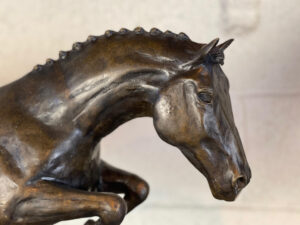
Across private estates, equestrian properties, and collector commissions, bronze horse sculpture holds a distinct position — combining anatomical accuracy with artistic interpretation to create work that captures both power and presence.
At scale, this challenge becomes even greater. A large bronze horse sculpture must not only represent the form, but embody movement, balance, and character within a three-dimensional space.
Understanding the Anatomy of the Horse
The foundation of any successful equestrian sculpture lies in anatomy.
A horse is not a static subject. It is defined by:
- Muscle structure
- Weight distribution
- Subtle shifts in movement
To create a convincing sculpture, the artist must understand:
- How the spine flexes in motion
- How weight transfers between legs
- How tension builds within the body
Without this understanding, even a technically correct sculpture can feel lifeless.
Capturing Movement in Bronze
Movement is not simply about position — it is about energy.
A horse in motion carries:
- Momentum
- Direction
- Intent
In bronze sculpture, this must be translated into:
- Flowing lines
- Balanced form
- Controlled tension
Whether capturing a rear, a canter, or a moment of stillness before movement, the sculpture must feel alive.
The Challenge of Scale
Scaling a horse sculpture introduces a new level of complexity.
A large-scale bronze horse sculpture must:
- Maintain anatomical accuracy
- Hold its form across distance
- Remain structurally sound
At this level, the sculpture is viewed both:
- From afar — as silhouette
- Up close — as detail
Balancing these two perspectives is essential.
Form, Balance and Engineering
Equestrian sculpture often involves dynamic poses.
This creates structural challenges:
- Weight distribution
- Load-bearing points
- Stability
The success of the sculpture depends on:
- Invisible engineering
- Careful internal structure
- Precise balance
When done correctly, the sculpture appears effortless — even in the most dynamic poses.
Expression and Character
Beyond anatomy and movement lies character.
A horse sculpture should capture:
- Energy
- Temperament
- Presence
This may be seen in:
- The tension of the neck
- The position of the ears
- The focus of the gaze
These subtle details transform the sculpture from representation into something more personal and expressive.
Bronze as the Ideal Material
Bronze is particularly suited to equestrian sculpture.
It allows for:
- Fine anatomical detail
- Smooth transitions in form
- Structural strength at scale
Over time, the patina of bronze enhances the work — adding depth and allowing the sculpture to integrate into its environment.
Equestrian Sculpture in Estates and Collections
Within private estates, bronze horse sculpture is often commissioned to:
- Reflect a connection to horses or land
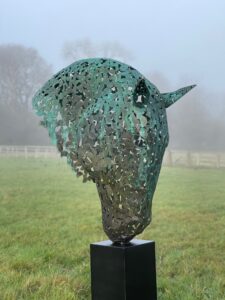
- Create a focal point within the landscape
- Capture a specific horse or moment
For collectors, these works often hold:
- Personal significance
- Emotional value
- Long-term presence
Commissioning a Bronze Horse Sculpture
A bespoke equestrian sculpture allows for:
- Accurate representation of a specific horse
- Control over scale and pose
- Integration into a particular setting
This process ensures that the final work is not generic, but entirely unique to the client and environment.
A Subject That Demands Mastery
The horse remains one of the most challenging subjects in sculpture.
It requires:
- Technical understanding
- Artistic sensitivity
- Material expertise
For this reason, equestrian sculpture is often seen as a defining test of a sculptor’s ability — where anatomy, movement, and form must come together seamlessly.
Final Thoughts
A bronze horse sculpture is more than a representation.
It is a study of movement, balance, and presence — captured in a material designed to endure.
At scale, it becomes not only a work of art, but a defining feature within a landscape or collection.
Enquire About Equestrian Sculpture
We create large-scale bronze horse sculptures for private estates, collectors, and equestrian properties worldwide.
Each piece is designed to capture movement, character, and lasting presence.