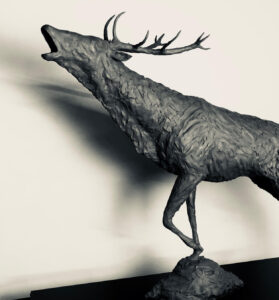
A Material of Structure
Steel introduces something different to a landscape.
Where planting is soft and evolving, steel is fixed and defined. It brings clarity to open space — a sense of structure that cannot be achieved through natural elements alone.
In contemporary gardens and architectural settings, steel sculpture is often used to create this contrast. Not as decoration, but as a deliberate intervention within the landscape.
Why Steel Works in Modern Gardens
Modern gardens are often designed with restraint.
Clean lines.
Open space.
Carefully considered materials.
Within this environment, sculpture must respond accordingly.
A steel garden sculpture offers:
— strong silhouette
— clarity of form
— consistency across distance
It does not rely on detail.
It relies on presence.
The Appeal of Oxidised Steel
In outdoor sculpture, surface matters as much as form.
Oxidised steel, often associated with corten-style finishes, has become a defining material in contemporary design.
It offers:
- A natural, weathered surface
- Warm tones that contrast with greenery
- A finish that evolves over time
Although often referred to as corten, the aesthetic is widely used across oxidised steel sculpture, creating a similar visual effect.
Form Over Detail
Unlike bronze, where detail is central, steel sculpture often focuses on form.
This includes:
— geometric shapes
— flowing abstract structures
— large-scale spheres and architectural pieces
A steel sphere sculpture, for example, works not through detail, but through proportion and balance.
The simplicity is intentional.
Placement Within the Garden
Steel sculpture performs best when given space.
It is often positioned:
- Within open lawns
- Along architectural lines
- As a focal point within minimal planting
In these settings, the sculpture defines the space rather than competing with it.
Scale and Visibility
Scale is critical in modern landscapes.
A sculpture must:
- Hold its form across distance
- Remain visually clear
- Maintain impact from multiple viewpoints
This is why large steel sculpture is often used in contemporary gardens — smaller pieces can lose their presence within open design.
Interaction with Architecture
Steel naturally aligns with modern architecture.
It works alongside:
— glass
— concrete
— stone
— structural steel
A modern steel sculpture can:
- Extend architectural lines
- Reinforce geometry
- Introduce balance within built environments
This connection makes it particularly effective in high-end residential and commercial projects.
Light, Shadow and Surface
Steel sculpture changes throughout the day.
Light creates:
- Sharp shadows
- Defined edges
- Shifting visual weight
Unlike reflective materials, oxidised steel absorbs light — creating depth rather than shine.
This subtlety is part of its appeal.
Durability and Longevity
Steel is chosen not only for its appearance, but for its performance.
A well-finished outdoor steel sculpture:
- Withstands environmental conditions
- Requires minimal maintenance
- Retains its structural integrity over time
This makes it suitable for both private gardens and public installations.
A Contemporary Statement
Steel sculpture is often used where a clear, modern statement is required.
It introduces:
- Precision
- Intent
- A defined visual language
In contrast to more traditional materials, it reflects a contemporary approach to both landscape and design.
— Key Questions —
Is steel suitable for outdoor sculpture?
Yes — particularly when finished to withstand weathering.
What is oxidised steel?
Steel that has developed a controlled surface layer, often associated with corten-style finishes.
Does steel sculpture require maintenance?
Minimal — it is designed for long-term outdoor use.
Where should steel sculpture be placed?
In open or structured spaces where its form can be clearly seen.
Is steel better than bronze?
They serve different purposes — steel is often used for modern, architectural forms, while bronze suits detailed and figurative work.
A Final Perspective
Steel does not attempt to imitate nature.
It stands apart from it.
In doing so, it defines space with clarity — introducing a level of precision that transforms how a landscape is experienced.
Within contemporary gardens and architectural environments, steel sculpture is not an addition.
It is a statement.
Enquiries
For modern steel sculpture commissions, including large-scale garden sculpture and architectural installations, we work with private clients, designers, and developers worldwide.