Introduction
Creating a racehorse sculpture is one of the most demanding disciplines within figurative art.
It requires more than an understanding of form — it demands a deep knowledge of anatomy, movement, and balance, combined with the ability to translate these qualities into a material that will endure.
Across private estates and equestrian collections, bronze racehorse sculpture holds a unique position. It is not simply about representation, but about capturing something far more complex — the energy, presence, and character of the horse itself.
Beyond Likeness
A successful racehorse sculpture is not defined by resemblance alone.
While accuracy is essential, it is only the starting point.
What distinguishes a great sculpture is its ability to convey:
- Tension within the body
- Direction of movement
- A sense of readiness or power
Without these qualities, even a well-proportioned piece can feel static.
The aim is not to copy the horse, but to interpret it in three dimensions, preserving both form and energy.
Understanding Equine Anatomy
At the core of equestrian sculpture is anatomical understanding.
A racehorse is defined by:
- Lean muscle structure
- Precise proportions
- Dynamic weight distribution
Capturing this requires an awareness of how the horse moves, including:
- The flexion of the spine
- The positioning of the legs in motion
- The relationship between tension and balance
These elements are often subtle, but they determine whether a sculpture feels convincing.
Capturing Movement
Movement is where racehorse sculpture becomes truly challenging.
Even in stillness, a horse carries motion.
A great sculpture must suggest:
- Forward momentum
- Controlled power
- The potential for movement
This is achieved through:
- Line and flow within the form
- Positioning of the limbs
- The overall balance of the piece
In large-scale bronze sculpture, this becomes even more important, as the work must remain coherent when viewed from multiple angles and distances.
Balance and Structure
Racehorse sculptures often involve dynamic poses — which introduce structural complexity.
The sculpture must be engineered to:
- Support its own weight
- Maintain stability over time
- Appear effortless, even in motion
This balance between artistry and engineering is critical.
When successful, the viewer is unaware of the technical considerations — seeing only the form and movement.
Expression and Character
Beyond anatomy and motion lies character.
A racehorse sculpture should capture:
- Focus
- Energy
- Temperament
These qualities are often conveyed through small details:
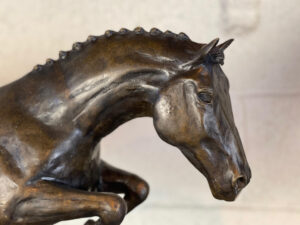
- The angle of the head
- The tension in the neck
- The positioning of the ears
Together, they create a sense of individuality — ensuring the sculpture feels alive, rather than generic.
The Role of Scale
Scale changes how a sculpture is experienced.
A large racehorse sculpture must:
- Hold presence across distance
- Maintain clarity of form
- Reveal detail as the viewer approaches
At this level, the sculpture operates in two ways:
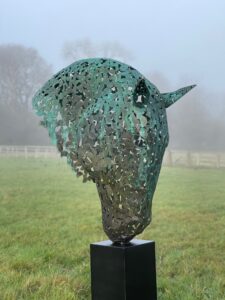
- As a silhouette within the landscape
- As a detailed work up close
Balancing these perspectives is essential to its success.
Why Bronze Is the Ideal Material
Bronze remains the preferred material for equestrian sculpture.
It allows for:
- Precision in detail
- Smooth transitions in form
- Structural strength at scale
Over time, bronze develops a natural patina, which enhances the sculpture and allows it to integrate into its surroundings.
This makes it particularly suited to outdoor and estate-based sculpture, where longevity is essential.
Relationship to Environment
A racehorse sculpture does not exist in isolation.
It is experienced within:
- Landscape
- Architecture
- Open space
Its success depends on how it interacts with:
- Light
- Surrounding elements
- Movement through the space
A well-placed sculpture becomes part of its environment — not separate from it.
A Measure of Artistic Skill
Within sculpture, the horse is often regarded as a test of ability.
It requires:
- Technical understanding
- Artistic interpretation
- Material knowledge
To successfully combine these elements is a mark of mastery.
This is why equestrian sculpture remains one of the most respected and challenging forms within the field.
Frequently Asked Questions
What makes a racehorse sculpture realistic?
A combination of accurate anatomy, correct proportions, and the ability to convey movement and balance.
Why is the horse a difficult subject to sculpt?
Because it involves complex anatomy, dynamic movement, and precise weight distribution.
Is bronze the best material for horse sculpture?
Yes — due to its strength, durability, and ability to capture fine detail.
How important is scale in horse sculpture?
Very important — especially for outdoor settings, where the sculpture must hold presence across distance.
Can a sculpture capture the personality of a horse?
Yes — through subtle details such as posture, tension, and expression.
Final Thoughts
A great racehorse sculpture is not defined by size or material alone.
It is defined by its ability to capture something intangible — the energy, balance, and presence of the horse.
Through a combination of anatomy, movement, and craftsmanship, the sculpture becomes more than a representation. It becomes a lasting interpretation of a subject that is constantly in motion.
Enquire About Equestrian Sculpture
We create large-scale bronze horse sculptures for private estates, collectors, and equestrian properties worldwide.
Each piece is designed to capture form, movement, and lasting presence.