Handcrafted at Scale – Where Heat, Metal and Time Shape Lasting Sculpture
There is a point in sculpture where refinement gives way to conviction.
It is the moment when metal is heated beyond resistance, when bronze begins to soften and steel yields just enough to move. That moment — governed by experience rather than instruction — has shaped my work for more than twenty-two years, and for over a decade as a full-time sculptor, it has defined how sculpture is made at Charles Elliott Sculpture.
This is not a studio driven by outsourcing or delegation. It is a place where sculpture is formed through heat, force, and hand-led decision making — the same fundamentals that have underpinned the most enduring sculptural practices for centuries.
“You can draw sculpture endlessly, but it only becomes real when heat is involved. That’s where judgement matters.”
— Charles Elliott
Sculpture Forged Through Process, Not Assembly
Large-scale bronze sculpture and monumental steel sculpture do not emerge from assembly. They are forged through process.
At the studio, raw materials arrive unformed — bronze sheet, steel plate, solid section — and are shaped progressively using heat, pressure, and controlled movement. Steel is heated and bent, curved and compressed. Bronze is worked while hot, cooled, refined, and returned to again and again.
This is a physical dialogue with material.
Each curve holds memory. Each weld, compression, and surface decision carries consequence — not just visually, but structurally and over time. This approach is essential when creating architectural sculpture, public art, and large-scale outdoor sculpture intended to endure for generations.
Tools With Weight, Tools With History
The workshop is equipped not only with modern fabrication equipment, but with machinery dating back to the 1920s — heavy, industrial tools designed to move metal decisively rather than delicately.
These machines allow bronze and steel to be manipulated in ways that modern lightweight alternatives simply cannot replicate. Material is persuaded rather than forced, compressed rather than weakened.
“Those older machines don’t rush you. They demand that you understand what the material is doing.”
This combination of historic equipment and contemporary engineering allows the studio to create large-scale bronze sculpture, oxidised steel sculpture, and rustic steel forms with confidence and control — qualities essential for sculpture commissioned for luxury estates, hotel environments, and significant architectural settings.
Bronze and Steel as Luxury Materials
Luxury in sculpture is rarely about surface alone.
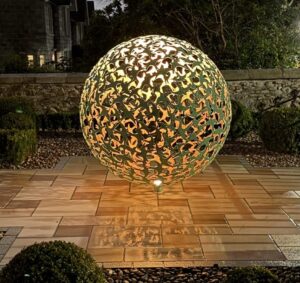
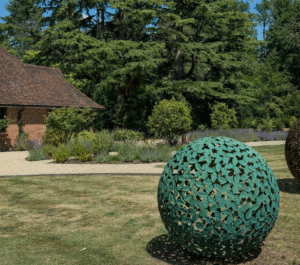
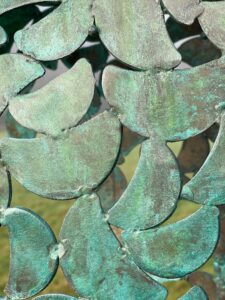
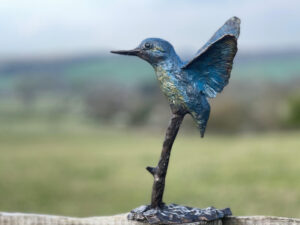
Bronze sculpture offers depth, warmth, and authority. Its weight carries historical resonance, while its finishes — polished bronze, traditional dark bronze, and verdigris bronze — allow sculpture to respond differently to light, landscape, and architecture.
Polished bronze is often specified for contemporary architectural contexts and high-end commercial interiors, where reflection and precision are key. Verdigris and dark bronze finishes are favoured for estate landscapes, public art, and settings where sculpture must settle naturally into place.
Oxidised steel sculpture — often referred to as Corten steel sculpture or rustic steel sculpture — offers an entirely different language. Its patinated surface absorbs light rather than reflecting it, allowing form, proportion, and mass to dominate.
Both materials share a common quality: they age with dignity.
Handcrafted Sculpture at Monumental Scale
The term “handcrafted” is often misunderstood.
At scale, it becomes essential.
Large-scale sculpture must account for weight, wind, fixing, balance, and long-term exposure. These considerations cannot be resolved purely through digital modelling or third-party fabrication. They require lived experience — an understanding of how material behaves under heat, stress, and time.
By shaping, welding, finishing, and assembling every sculpture in-house, the studio maintains complete continuity between concept and execution. This integrated approach is increasingly rare, yet it is precisely what enables the creation of monumental bronze sculpture and architectural steel sculpture that perform both visually and structurally.
Sculpture Made to Outlast Its Setting
The ambition has never been to create sculpture that peaks on installation day.
Every piece is designed to remain outdoors for 100 years or more, responding to weather, climate, and environment rather than resisting them. This philosophy has guided work for private estates, luxury hotels, commercial developments, and public art commissions across the UK and internationally.
“If sculpture doesn’t improve with time, it hasn’t been finished properly.”
Bronze and steel are chosen not for convenience, but for their ability to develop character — to deepen, soften, and settle into place.
A Rare Continuity in Contemporary Sculpture
To design, fabricate, and finish sculpture entirely within one studio is no longer common practice.
Yet this continuity remains central to Charles Elliott Sculpture. It allows decisions about scale, structure, and finish to be made holistically — with full awareness of how sculpture will be installed, viewed, and lived with.
For architects, landscape designers, curators, developers, and collectors, this offers something increasingly rare: a sculptor who understands not only how sculpture should look, but how it is made, moved, installed, and sustained over time.
A Quiet Invitation
As the studio continues to work on large-scale bronze and steel sculpture for architectural, commercial, and landscape settings — both in the UK and internationally — the process remains unchanged.
Heat.
Material.
Hands-on making.
Time.
For those considering bespoke bronze sculpture, oxidised steel sculpture, or architectural sculpture of scale, early conversations often begin quietly — with questions of place, proportion, and longevity.
Charles Elliott welcomes considered enquiries where sculpture is viewed not as an object, but as a lasting contribution to its environment.